Shiva Worship — The God Who Burned Me Down to Build Me Back

I grew up with Krishna's flute in my ears.
Long before I understood what devotion meant, I knew the blue of his skin, the peacock feather tilted just so, the sweetness of butter stolen from a mother's kitchen. Krishna was the deity of my childhood altar, my wedding mandap, my late-night prayers when nothing made sense and I needed something to feel like play instead of pain. He was joy. He was the friend who danced with you even when your world was falling apart. For most of my life, I didn't think I needed anyone else.
Then, three years ago, everything I thought I was finished collapsing.
I won't pretend the collapse was gentle. It wasn't a single event so much as a slow unraveling — the version of myself I had built for other people, the roles I'd outgrown but kept performing anyway, the beliefs I'd inherited without ever asking if they were mine. Krishna had taught me how to love through the chaos. But there was something underneath the chaos that needed to be ended, not loved around. And that is when Shiva walked in.
The God I Was Afraid Of
I want to be honest about something: I resisted him at first.
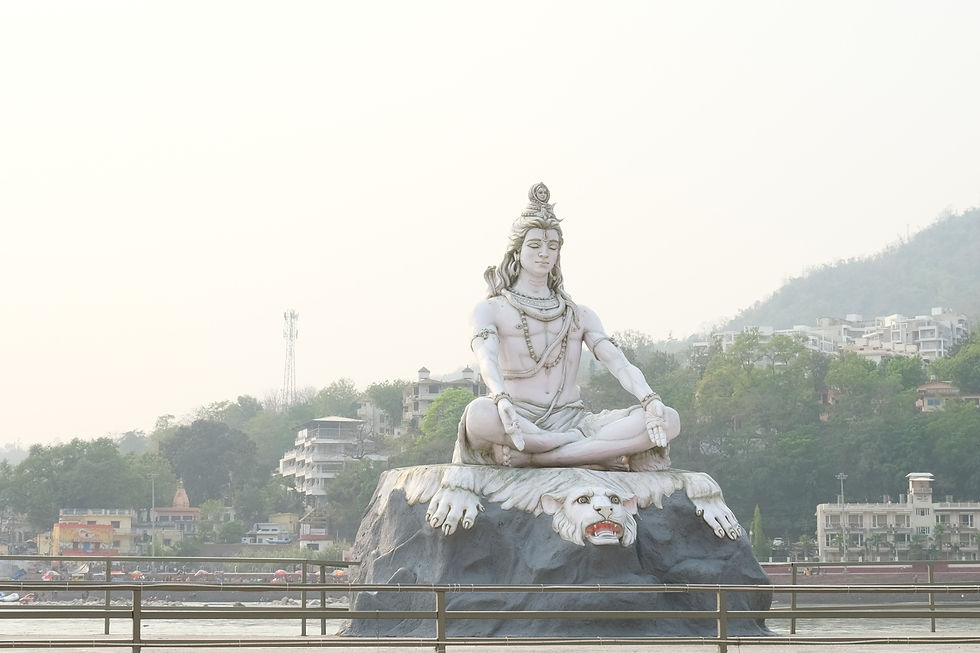
Shiva is not a gentle deity to meet when you are already breaking. He is the ash-smeared ascetic sitting in cremation grounds, the destroyer of worlds, the wild-haired yogi who burns down illusion without asking your permission first. Everything I had been taught to associate with the divine — softness, sweetness, safety — felt absent in him. He terrified me a little. He still does, in the way that truth often does.
But the more I sat with him — in meditation, in the low hum of "Om Namah Shivaya" repeated until the words stopped being words — the more I understood that his fire wasn't cruelty. It was mercy in a form I hadn't been ready to recognize. Shiva doesn't destroy what is precious. He destroys what is false. And I had so much that was false.
What Death Actually Felt Like
People talk about spiritual transformation like it's a glow-up. It wasn't that, not for me. It felt like grief. It felt like watching a version of myself — one I had spent years defending, justifying, dressing up as "who I really am" — dissolve, piece by piece, and not being able to stop it or wanting to, both at once.
Old friendships that ran on my silence stopped working. A career I'd built on proving myself to people who never asked me to started to feel like a costume. Patterns of self-abandonment I'd mistaken for love simply stopped making sense. None of it was taken from me violently. It just stopped being able to survive in the presence of something so unflinchingly real.
This is the part no one tells you about Shiva: his destruction is never the end of the story. It is the ground-clearing. You cannot plant anything new in soil that is still crowded with the dead roots of who you used to be. He tore mine up. All of it. And underneath, impossibly, there was still something alive.
What My Chart Already Knew
It wasn't until I sat down with a Vedic astrologer, almost a year into this unraveling, that I understood why this particular god, at this particular moment, had come looking for me.
She looked at my chart and paused on one placement in particular: my Moon, sitting in my first house, in Pisces. In Vedic astrology, the Moon is the mind itself — the manas, the ever-moving, ever-feeling instrument through which we experience the world. Mine isn't tucked quietly into some back corner of my chart. It's sitting right in the first house, the house of self, identity, the face I show the world before I've said a single word. My entire sense of who I am is filtered through emotion, intuition, absorption — and in Pisces, the moon doesn't just feel things, it dissolves into them. Pisces is the last sign of the zodiac, the sign of surrender, of boundaries going soft, of the individual self quietly merging back into something larger.
Shiva's name is quite literally written into his iconography: he is Chandrashekhara — the one who wears the crescent moon in his hair. Not the moon as ornament, but the moon as something he holds, contains, governs. In the old stories, it is Shiva who catches the moon when it is waning, dying, poison-drenched, and places it gently on his own head, steadying it, keeping it from disappearing completely. He is, quite literally, the lord who governs the mind's dissolution — the one force powerful and still enough to hold a Pisces Moon without letting it drown.
My astrologer didn't have to explain much further. My isht devata wasn't a matter of preference. It was written into the exact placement that makes me who I am. Krishna had given my moon somewhere joyful to move. But my moon didn't need more movement. It needed someone still enough to hold it.
Why I Worship Him Now
I still love Krishna. That devotion doesn't disappear — it just isn't where my growth lives anymore. Right now, in this chapter of my life, I need Shiva's particular medicine: the stillness of the meditator who can sit beside an ocean of feeling without being swept into it. The one who doesn't ask a Pisces Moon to become less sensitive, less porous, less permeable to the world — only to find the stillness underneath all that feeling, the witness that doesn't dissolve even when everything else does.
Worshipping him has taught me to stop being afraid of my own endings. Relationships end. Identities end. Old ways of loving myself end. And every single time, what rises afterward is more honest than what came before — steadier, too, the way a moon looks calmer once it has somewhere solid to rest.
If you are in a season where everything feels like it's falling apart, I won't tell you it's nothing. I won't tell you to just have faith and wait for the light. What I'll tell you is this: sometimes the fire is the faith. Sometimes the god who shows up isn't the one who saves you from the burning — he's the one who lights it, stays beside you inside it, and waits, unbothered, for what's real in you to walk out the other side.
That is what I found three years ago. Not comfort. Not even peace, at first.
Just the truth, unafraid of the ash it left behind.


Comments